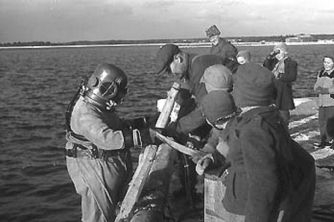
Diver in
Carlsson rig about to descent
Photo courtesy of our friend Mikael Zingmark.
Axel Emil Carlsson 1876 – 1954
1910 diver Emil Carlsson opens his firm and named it Dykerifirma Emil Carlsson, in 1925 Emil Carlsson builds a new home for his family and a new workshop at Falugatan 7 in Stockholm. Also in 1925 he named the firm Dykerifirma Emil Carlsson & Son AB. In 1940 Emil Carlsson & Son AB celebrated 30 year's in the diving industry and one of the new pieces of equipment of that year catalog was a 12 bolt breastplate, it was made to fit the standard four bolt bonnet.
In 1951 Emil Carlsson retires and his son in law Fritiof Morell takes over the firm and runs it until his death 1976. In summer of 1976 Diving Company Emil Carlsson & Son AB is sold to Diving Company Hajen in Uddevalla on the Swedish west coast.
Mikael Zingmark is trying to set up a register on Emil Carlsson helmets, and this will help us to find out how many helmets he made and also where they are now. If you have an Emil Carlsson helmet and you would like to help him with this register please email him at divinghelmet@telia.com
|
|
|
Diver in
Carlsson rig about to descent |
|
|
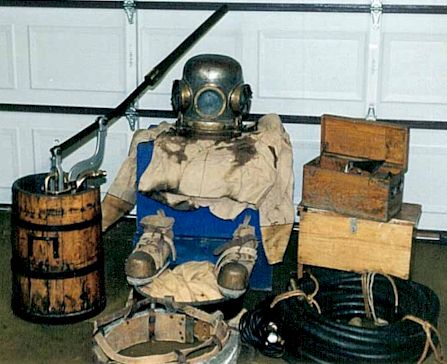
| Fantastic
early Carlsson rig. These
helmets were referred to as cooking pots. They feature three lights and 4
wingnuts. This particular set is one of the oldest Swedish ones we have ever
seen. Note the fantastic airpump! The comm line is INSIDE the airhose. Photo
courtesy of John Durham. |
A closer look at the early Carlsson
|
|
|
|
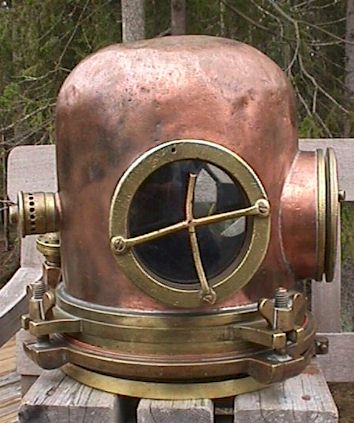
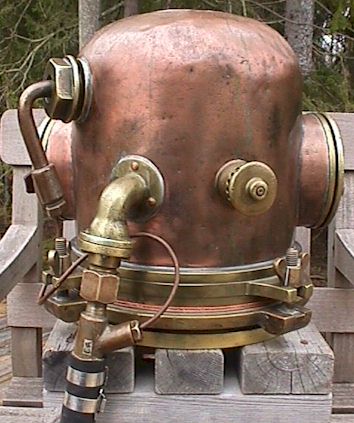
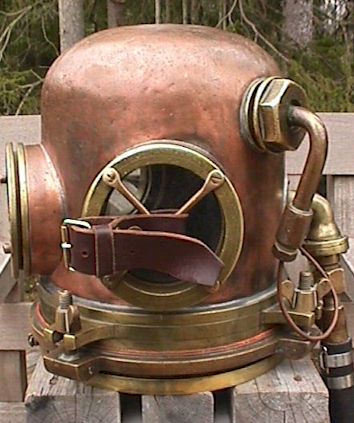
This is one of the earliest Carlsson helmets we have ever seen. It has a crowned top and dates from around 1900. The interesting thing about this helmet is that the comm line goes INSIDE the airhose, like with the first helmet pictured in this section. You can clearly see the original coupling (which is stamped EA for Erik Anderson) and how the comm line eventually exits the airhose and enters the comm elbow on the helmet. The leather belt is intended to mount the airhose to the side of the helmet. What a great looking hat! Photo courtesy: Mikael Zingmark. |
|
|
|
|
|
|
|
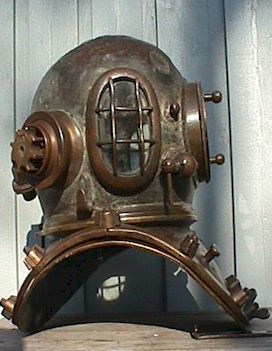
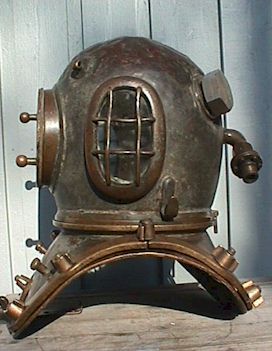
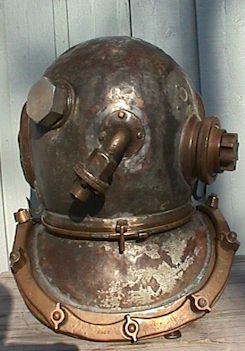
Another
Carlsson type helmet. Not a real Carlsson but an unknown producer. |
 |
|
|
|
Another Carlsson
type helmet. Not a real Carlsson but an unknown producer. |
||
|
|
|
|
Early style
Carlsson helmet. Notice how much the side light frames extend!. |
|
Carlsson AB Style Helmet
In 1925 the Company changed its
name to Dykerfirma Emil Carlsson & Son AB.
In 1940 the Company introduced a new style of helmet which in common with other
helmet makers had a 12 bolt style breastplate at this time.
Originally this helmet retained the 4 bolt locking ring mechanism which secured
the helmet to the corselet or breastplate.
The heavy brass neckring increased the weight of the helmet by some 10 lbs or
4.5 Kgs and later it was replaced by the interrupted thread mechanism
favoured by nearly all the World's producers of helmets although of course there
were a few styles which differed.
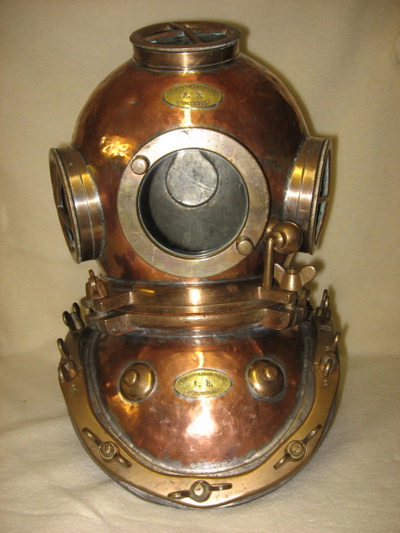
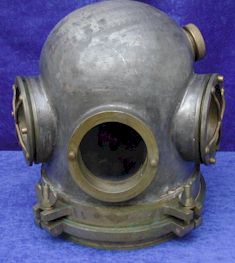
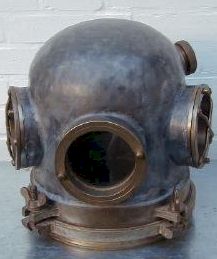
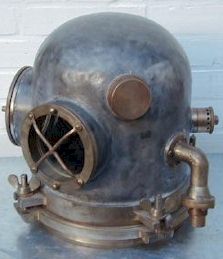
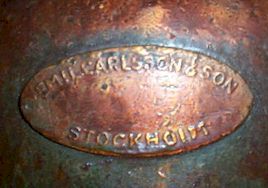
Seen above is a Carlsson 12 bolt /4 bolt helmet with 4 windows. It has a spitcock which unusually has the lever on the inside a feature common with Swedish helmets. The wing nuts are large and there are 2 makers badges one on the breastplate and one on the bonnet. The helmet is very well made and the top of the helmet soldered on to the body of the bonnet indicating the helmet was hand made not machine spun.
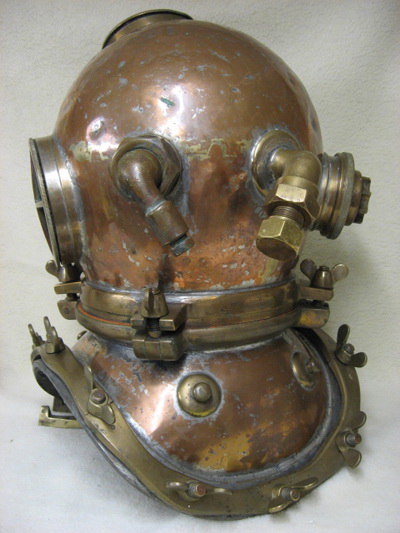
The rear view of the helmet shows
the air inlet gooseneck and telephone connection and the large exhaust developed
by Arne Zetterstrom.
All the brass parts for the Carlsson helmet were made by Erik Anderson and sis
initials are cast into the brales. Looking carefully you can clearly see the
solder line where the crown of the helmet is attached to the body of the helmet.
Carl Axel Lindqvist 1828 -1904
C.A Lindqvist made the first type of diving helmets with the four bolted
neckring that we today call the Carlsson helmet, we have not found out exact
when the first Lindqvist helmet was produced but it was probably in the early
1880’s.
|
|
|
|
|
|
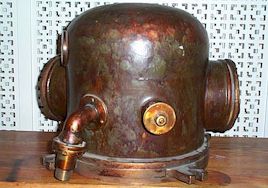
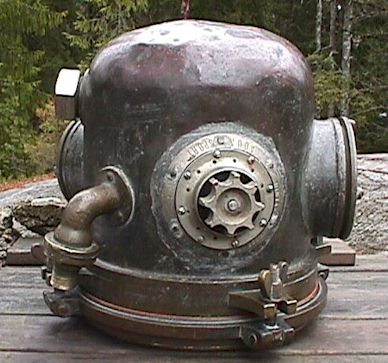
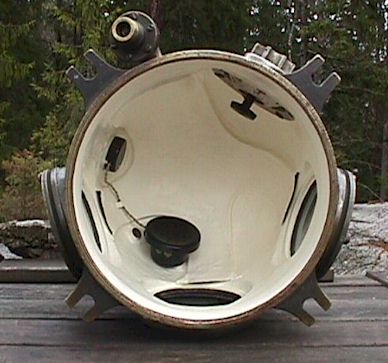
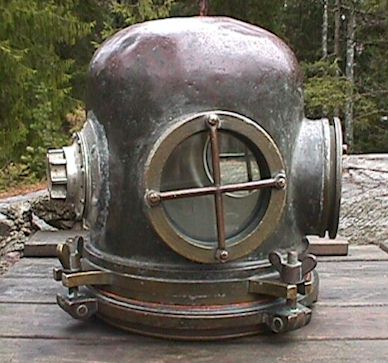
This helmet has a crowned top . The air exhaust is made by the Swedish compant Poseidon who still make regulators and drysuits like the popular Unisuit.
It has a 4 bolt neckring, and on the pictures you can see the bottom neckring has a ring mounting on it , that thin ring goes outside of the dress and it is screwed to a watertight seal, the dress going between the thin ring and the neckring. The rubber gasket you see on top of the neckring is where the bonnet is placed and only the bonnet and not the dress.
Here we find the makers name stamped into the neckring C.A. LINDQVIST.
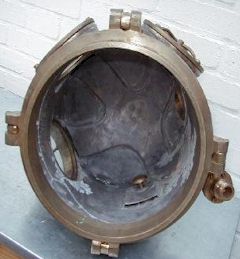
Inside you see how the airchannels are made, this is a really heavy helmet the thickness of the copper is much heavier much heavier than say a Siebe Gorman , although the size is much smaller than a Siebe Gorman , more like the size of a small volume helmet from say America with enough room forv the divers head but not much room to move around in there.
Photo courtesy of Mikael Zingmark
Erik Anderson
Diving equipment manufacturer from Stockholm, Sweden. Anderson produced all the brass parts for Emil Carlsson helmets and pumps. No further information available at this moment. Can you help? Please contact us !
A strange looking Siebe Gorman
Have a look at the 12 bolt Siebe Gorman helmet below. It was dated to late 1890 by John Bevan. It has some modifications made to it by Erik Andersson.
|
|
|
|
The man
responsible for the design of the strange looking air exhaust is Arne
Zetterström, he is very well known in Sweden for is Hydrox dives in
the 1940's. He died in 1945 in a mixed gas diving accident. The air
exhaust is made by Erik Andersson who did all the brass parts for Emil
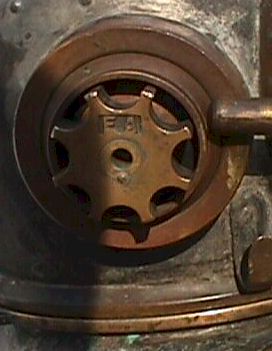
Carlsson helmets and pumps. Look at the wheel: It is stamped EA. |
|
|
|
|
last edited on 31st October 2011