The Oceantech
Minibell system
 Up until 1986, the air diver was
still going to work as air divers had done for decades, i.e. jumping over the
back of a boat. In the case of rigs or platforms, and DSV's , some companies
used submersible basket systems, as a means to get in and out of the water. All
these methods have an inherent danger. The
Surface Interval.
Up until 1986, the air diver was
still going to work as air divers had done for decades, i.e. jumping over the
back of a boat. In the case of rigs or platforms, and DSV's , some companies
used submersible basket systems, as a means to get in and out of the water. All
these methods have an inherent danger. The
Surface Interval.
Owing to the increase in
incidents of decompression sickness in the late 70's early 80's, the Health and
Safety Executive, (HSE) which governs all inshore and offshore diving
activities, placed a restriction on bottom
times, for all commercial air diving in the UK.
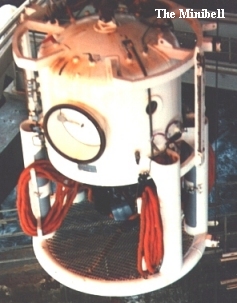
The Minibell air diving system
was developed by Ocean Technical Services Ltd in the early 80's. The system was
designed in modular form, allowing it to be mobilized on platforms, rig's and on
board DSV's.
The system consisted of :- Bell
winch module, TUP module, Twin Chamber module, all
containerized, a Minibell and
the Clump weight (secondary lift).
The Minibell system was first
used operationally in 1986 in the North Sea, working for Conoco on the Viking
field, platform complex. The Minibell system allowed two
divers to enter the water, either sitting on the staging under the bell or in
the bell with the door open, both divers dressed in ready to go to work.
| Once the bell was within 33ft of
the working depth, the decent was halted and diver1 went out to work, being
tended by diver 2. Once diver 1 was at the work site, then diver 2 would blow
all the water out of the bell and then proceed to the work site. Approximately 5 - 10 minutes
before allowable bottom time was up, diver 1 would return to the bell, rack up
his umbilical, and make ready to bring diver 2 back to the bell.
Both divers at the bell and
umbilicals racked up on the staging, one diver would enter the bell remove his
hat and hang it on the outside of the door, then assist the other diver into the
bell and hang his hat on the outside of the door. The door was then closed, the
bell lifted to get a seal on the door, the bell was then recovered to the
system, the divers having vented the bell to the first stop pressure on route.
The bell locked on and brought up to the transfer pressure. Both divers would
lock through to the end chamber and begin decompression, leaving the bell and
the first chamber free for the next dive. |

|
|
The bell on
its way to work. 2 divers sitting on the staging |
As with all air diving, there was
still a standby diver basket system, with the diver dressed in ready to go. But
in waters where the visibility was poor, the second Minibell diver would stay at
the bell and tend the other diver from the staging. The surface standby diver is
required by law, and even when there was only one diver working away from the
bell, the standby diver is always dressed in.
This system (although working on
a dispensation from the HSE each year) was not governed by the bottom time
limitations, as it dispensed with the surface interval, and allowed
decompression to be controlled from start to finish.
|
|
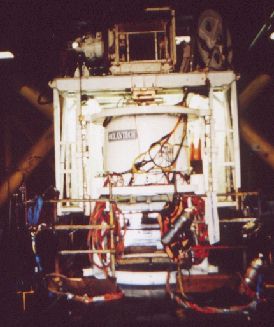
the system installed on the CONOCO Viking platform. The system was moved three times during the season,
to different jackets on the complex, and completed the season without an incident of decompression
sickness. It's first location on the CONOCO 'A' platform was on the lower deck (spider deck) and for
insurance purposes the whole system had to be rigged to enable it to be winched up to allow an air gap of
around twenty feet between the deck and the underside of the system, quite a feat.
|
|
This system not only gave the
client 100% more bottom time than conventional air diving methods, but it also
gave the diver a much greater safety factor. I was privileged to take out the
first Minibell system for Oceantech, and throughout the season, we did not have
any problems with decompression sickness. Many visitors came to check out the
Minibell and all were impressed, but this did not stop rival diving companies
trying their very best to have this system banned.
I went to various seminars along
with the management of Oceantech, to explain the workings of the system and the
obvious safety advantage to the divers using the system, but the opposition was
fierce. Basically it was all down to money, whilst the Minibell was picking up
all the air diving work in the Southern sector of the North Sea, the companies
using the conventional diving systems were governed by the restrictions laid
down by the HSE.
The Minibell continued to work
through till the early 90's, being further developed. Adding umbilical wheels on
each side of the bell, which allowed both divers to stay on the work site for
that little bit longer, and via a switch worn on the harness could operate the
wheels to wind the umbilical back to the bell. It is a great pity that this
system was not taken up by other diving companies, but I guess money will always
be the deciding factor, not safety as it should be.
VJ
Courtesy: Vic Johns, Devon
England