Introduction
The hose-pipe that was needed to get fresh air down from the surface to the diver, has always been a source of danger. The pipe might be crushed, fold or torn. Also, when diving in the current the pressure of the current would press against the hose-pipe and thus also against the diver. For these reasons diving equipment with no surface air supply was designed. The principle of the closed circuit apparatus is that the wearer continues to breathe the same air, the CO2 being removed from the exhaled breath by a chemical absorbent and replenished automatically with the requisite amount of oxygen, thus rendering it pure and fit for inhalation again.
| One of the first guys that came up with something was Charles Condert. His idea was published in october 1835. This American developed a "self contained diving dress" that looked a lot like William James' design. He also used a copper helmet. The suit consisted of two parts and had a rubber coating. A horseshoe shaped copper reservoir was carried around the waist and kept in place by shoulder straps. Air entered the hat via a manually operated valve. Exhaled air escaped thru a little hole on the top of the helmet. This system was far from ideal. During a testdive in east river in Brooklyn a pipe between the reservoir and the helmet broke and Condert drowned. | |
Some more names and dates:
Dräger DM-40
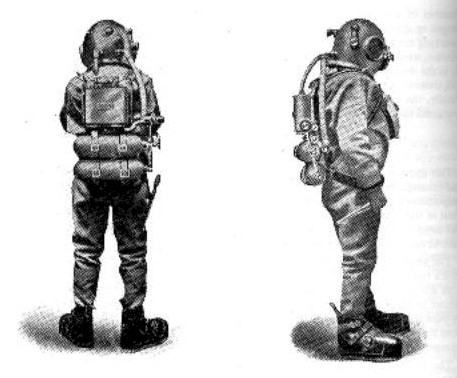
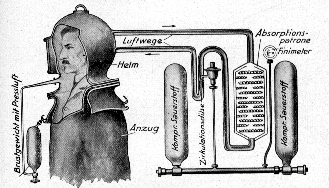
The Dräger company from Lübeck Germany produced the first "pipeless" diving equipment in 1909. The diver carries the device on the back. It contains: two cylinders of compressed air, one Alkali unit, an injector, a pressure gauge and a pressure reducing valve. In the picture you can see how the two oxygen tanks operate the injector thru the pressure reducing valve, that sucks air form the helmet thru the Alkali unit and presses it back in the helmet as fresh air. The membrane in the pressure reducing valve reacts on water pressure.
|
On his chest the
diver carries a air-chest weight. In case of an emergency the diver can
initiate his own ascend. This device could only be used up to 20 meters of depth ! The supply of pure oxygen would be dangerous is greater depths. In 20 meters of depths the maximum dive time was about 2 hours. This could be dangerous also when constantly breathing pure oxygen. However, there was of course a large amount of nitrogen in the suit so the inhaled gas was never exactly 100 % oxygen. |
For greater depths (up to 40 meters) one oxygen tank was replaced with one compressed air tank. The tanks were opened at the same moment so 50 % air and 50 % oxygen would be inhaled. Varieties in the mixture were achieved by changing the bottle sizes and pressures in them. Big advantage of this method is that you do not have to mix gasses, before putting it in the tanks.
To also make the 40 meter equipment suitable to stay down for 2 to 4 hours, the tanks are bigger. This includes the tank in the air-chest weight that has to be filled with compressed air instead of oxygen on the 40 meter equipment for obvious reasons.
Thus there where two types:
Dräger Girdle Equipment
This equipment was called like this because it could be divided at the girdle. It was a smaller version of the DM-40, suitable for depths up to 20 meters for one hour. Especially designed to take aboard ships. The equipment only had 1 oxygen tank and a small Alkali compartment. |
Siebe Gorman
Of course, Siebe Gorman was in the self-contained diving apparatus business as well. The company mentions the advantages of this equipment for warfare: the reason is simple! You don't see bubbles ! In peacetime it could be used in flooded mines or any other place where "hosepipe surface contact" was not possible, like work in shallow water, requiring great mobility or working on ships bottoms. On Siebe apparatus, tanks and CO2 absorbent chamber were sometimes used horizontally and sometimes vertically.
Siebe Gorman produced two types:
Mouthpiece and Nose clip Breathing Equipment
|
|
|
Mouthpiece and Nose clip Breathing Equipment |
This equipment consists of the standard dress and helmet. One or two steel cylinders with a mixture of air and oxygen, a metal chamber containing CO2 absorbent, an air-chest weight containing two small bottles with a mixture of oxygen and air, connected to an air inlet valve on the helmet.
The steel cylinders on the back feature a reducing valve to allow the adequate mixture to flow into the helmet, at the varying depths that the diver may be working in. Inside the helmet is a rubber mouthpiece, connected to the CO2 absorbent chamber by a hose and a expiratory valve. Exhaled breath ends up in the chamber. On the other side of the mouthpiece you find an inspiratory valve which is open to the helmet. All the air that the diver inhales goes through this valve. The diver wears a nose clip so no exhaled air can end in the helmet. Inside the absorbent chamber the air is freed of its carbonic acid. Oxygen and air is added and then it re-enters the helmet.
Injector Type
This type is practically the same as above. But now an injector is used which, in combination with a reducing valve, automatically draws the diver's exhaled air through the CO2 absorbent. It passes it, purified, back into the helmet, together with fresh oxygen. mouthpiece and nose clip are not needed.
Other manufacturers
Of course there were more companies that produced this type of apparatus. But in principle they all operated via the same technology. If we find anything interesting we will add it of course.