|
|
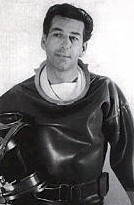
Joe Savoie of Boutte, Louisiana USA deserves the
credits for the first design of a practical lightweight helmet with a rubber
neck dam seal. Joe passed away on march 10 1996, just after he celebrated his 70th birthday.
|
|
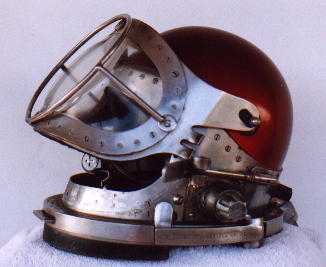
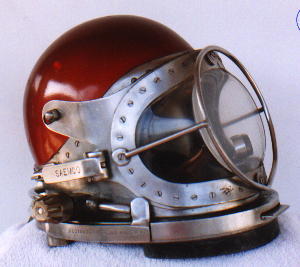
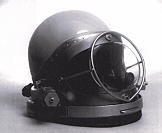
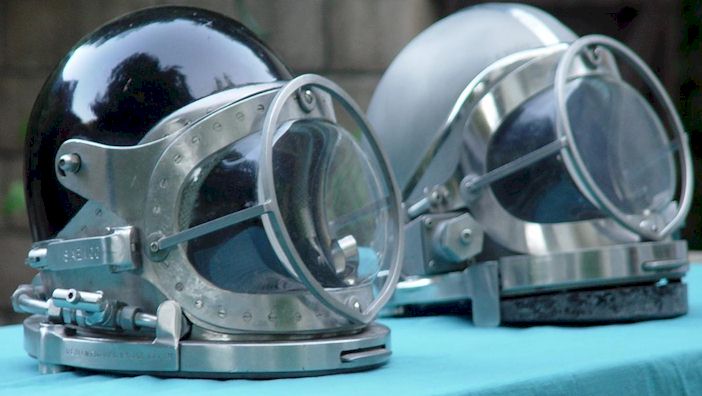
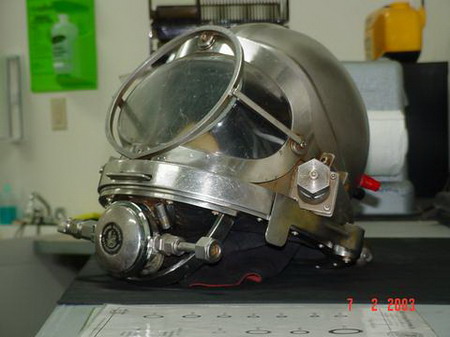
Joe Savoie Diving Helmet # 1
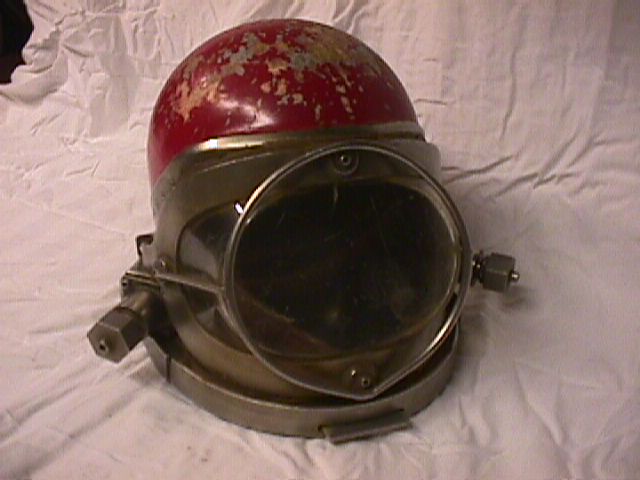
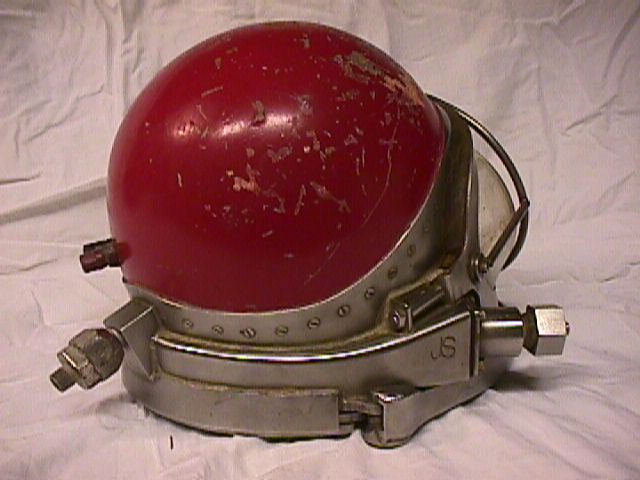
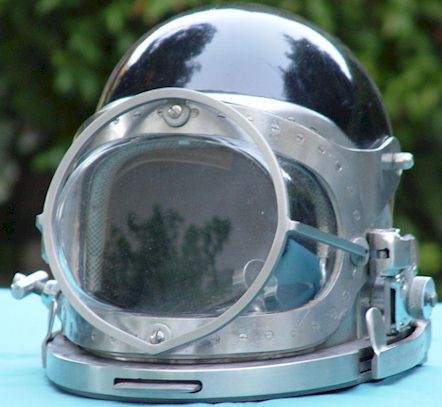
When Joe worked as a professional diver his company used old material like converted Mark V's and converted gasmasks. He did not like this and decided to design a new helmet. He used an Italian racing helmet and fitted his own steel fittings as components. The helmet turned out to work perfect. As we mentioned before, it was the first helmet with a neck dam seal, allowing the diver to work in any position. The helmet was also known as a "flip-up". The face port could be opened and swung up to the top of the helmet. It started with one helmet for personal use. Later Joe built helmets for his colleagues in the diving firm and after that for divers all over the world.
|
|
|
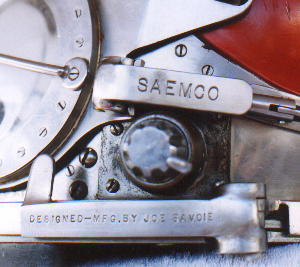
| A very nicely preserved #1 helmet. Notice the company logo Savoie's Engineering and Manufacturing Company. Photo courtesy of our valuable contributor Leon Lyons. |
|
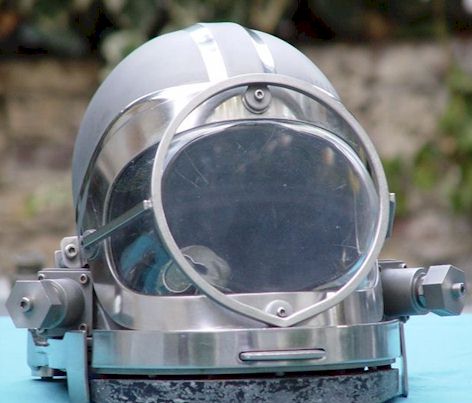
Joe Savoie Diving Helmet # 2
|
|
It did not take
a long time for the Savoie helmet to be known all over America. There was
a big demand for the helmet. Joe changed the design and eliminated the
flip-up feature, air control and exhaust valves were improved. The first
of these new models still had the racing helmet as a head shell. In 1971
Joe decided to use a steel shell. Over the years Joe produced several
hundreds fiberglass and steel freeflow helmets for air and mixed gas
diving and a limited number of demand regulator helmets.
|
|
|
|
|
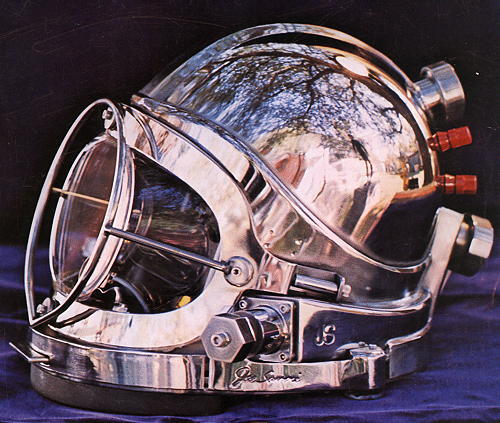
Pictures
contributed by professional diver Magnus Lundbeck from Sweden. Look at the
picture on the right: you can clearly see Joe's initials ! What a
fantastic helmet. |
|
|
|
|
Style 2 helmet in stainless steel. A rare and nice piece of equipment! |
The Savoie helmet was the example for all the other lightweight diving helmets that have been built since.
Do you have stories to tell??
Joe was a famous man. No wonder many guys in the commercial field knew him or worked with him. Do you have a story to tell? Do not hesitate and contact us!
The following was contributed by Ed Fogderud
Hi
Bert,
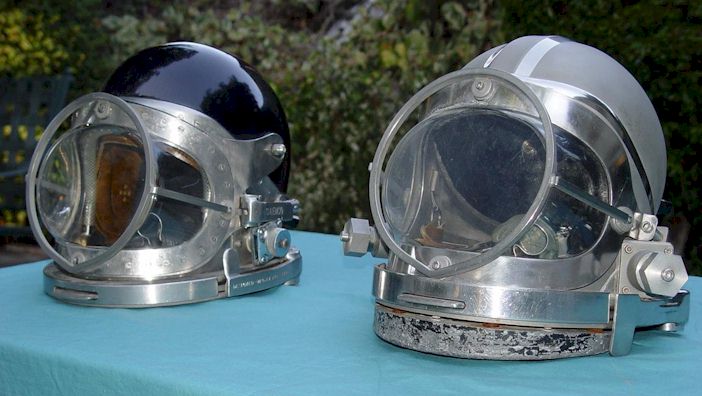
I ran across these shots of my two Savoie’s. The interesting thing about them is that my SS was one of the last that Joe went through before his passing and the Flip-up was the 13th and last one he made. I bought the Flip-up from the original owner who never used it. It just sat on his shelf for fifteen years, before I located and bought it.
Ed Fogderud
|
|
|
|
|
|
|
|
|
The following was contributed by Gary Black
The following was contributed by Jesse Dean:
I was looking at the Savoie tribute on your site and was reminded of a couple stories about Joe. I first met Joe
in November 1963. I had just arrived in Louisiana, straight out of Coastal School of Deepsea Diving of Oakland,
Ca.. Joe accepted me as a commercial diver, which surprised me, and I worked with him on many jobs in the
Gulf of Mexico while we worked for Dick Evans Professional Divers. Joe constantly talked about the new
helmet he was working on. One day Joe showed up with his helmet and a clipping I had already seen from the
local News Paper, which chronicaled Joes helmet with a picture of Joe, who had just dove his helmet, in the
Harvey Canal, for the reporters photo shoot.
You might be interested in the Aquala Green Rubber Drysuit Joe is wearing in your photo of him. Joe and I
were working on a salvage job in 220 feet of water, in the Gulf of Mexico in early 1964. Joe dressed in and was
preparing to go to 185 feet when Lee Ingersol and Walter Daspit both told Joe he couldn't dive to that depth
without getting a suit squeeze. Well Joe didn't mince words and abruptly told everyone who would listen that
he would dive the suit and that he would not get a squeeze. He was wearing a Scott Hydro Pak Demand mask
which had been modified for free flow with a valve. The mask was designed to build positive pressure by use of
an air tube running under the faceplate to the exhaust which blocked the exhaust by air pressure when the
freeflow button was pressed, in the middle of the demand regulator.
Joe grabbed a rather large galvanized shackle and attached it to his weightbelt for added weight. After the
successful, Squeeze Free, dive, joe took me aside and showed me his secret. Joe had installed exhaust
flapper valves on the inside of both suit legs, at the area of the anchles. Joe said that as he went down, head
first, he would blow air past the skirt of the Scott mask by holding the purge button down and the air would
enter the suit at the attached rubber hood and exit at the anchle exhaust flappers. I don't recall if Joe made a
bet but he did win the argument. This was probably the first use of a drysuit with a full face mask in that deep
of water, without a squeeze.
Joe had an answer for many of the problems he encountered in his commercial diving career. Joe had a sixth
grade education with an Ensteine brain and plenty of curriosity and the will to solve any task. Joe was a great
mentor.
I designed my helmet with a few tips and help from Joe. He let me dive his first helmet, before he built number
two. He got a bit upset because I put a big chip in the top of the helmet when he pulled me up, from 110' when
our compressor quit. He was still proud that his hat had helped me surface without getting hurt, from under an
oil platform. I do remember both my ears were folded down because Joes first helmet was a rather small fit. I
have fond memories of Joe and Joice. I spent a lot of memorable days at his little shop, just BS.ing with Joe.
I could tell some more stories about Joe but enough for now.
Jesse Dean
| Dear Karin
and Bert, I enjoyed finding your fine web page. The attached picture is my Savoie Demand Hat that I have been working since 1980. I am a working Diver and Dive Supervisor and published author. I own two Savoie Hats, the demand hat and one of the fiberglass air hats. I would enjoy gathering pictures and writing a piece on Joe. He was truly a one of a kind. All the best, John Carl Roat |
|
|
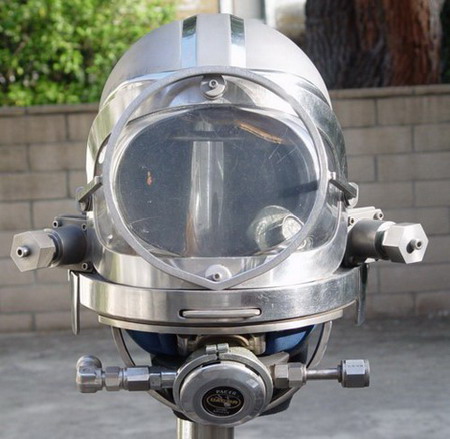 |
Here we have another Joe
Savoie stainless steel helmet with a demand valve fitted. We understand from Gary Harris that there were only 8 of these helmets with a 'factory' fitted demand valve.
It is believed however there
may be more as some divers |
|
| A side view
of the demand regulator. The trademark signature can be clearly seen on the lower part of the helmet. |
 |
|
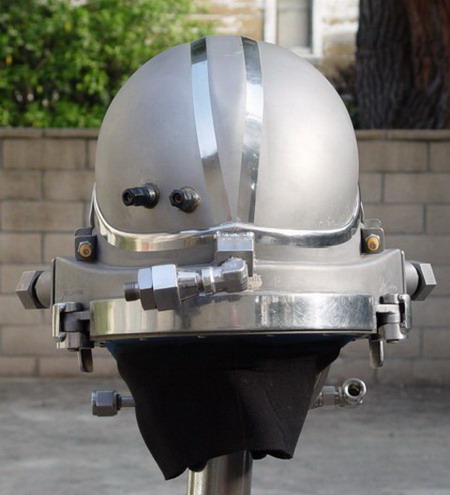 |
The rear view of the demand
regulator showing the comms posts and the air inlet connection. The neoprene neck dam which was the whole essence of the helmet can be seen hanging below the helmet. |
|
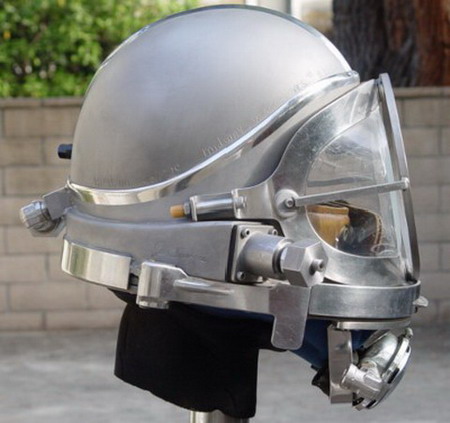
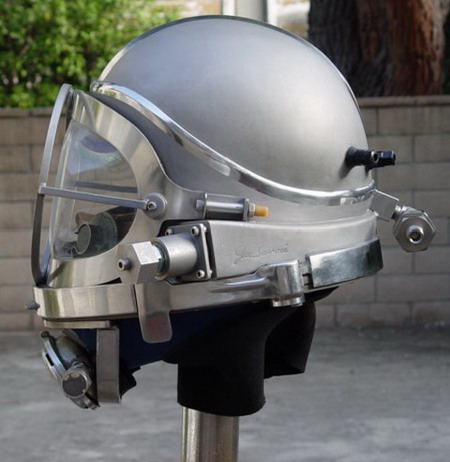
| The other
side view of the Joe Savoie stainless steel air helmet shows the clamping handle which secures the neck dam clamp to the helmet.
In the bottom of the faceglass
you can see the The helmet is weighted
using a lead weight which |
 |
|
|
A Joe Savoie helmet story
recounted by Dave Stallwood in his own words.
A brief recollection from Brian Dunn:
Brian writes, My Brother used to
have a Joe Savoie hat Style 2. He stopped diving for Taylor Diving in the
late 70s.
Brian Dunn
I knew Gary Savoie and Joe
Savoie. I knew Gary from when I worked at Taylor Diving and Salvage. I
bought my stainless steel helmet at Joe's house, got to meet the whole
family. I still remember the times I worked with Gary in the shop and the
other guys. I wonder if Gary Savoie is still alive. I know I witnessed a
part of history of diving. I tell my friends about my experiences and the
people, and life in the oilpatch. There is times at night before I go to
sleep that I think about that part of my life and the people who were part
of that past, Taylor Diving, The Gulf of Mexico and the North Sea.I always
remember the Christmas party that Taylor Diving had. Joe was there with his
own bottle of Crown Royal, happy as could be.
A Note from Brandy, Joe’s Niece Just wanted to let you all know that, I really enjoyed this piece on Joe Savoie. It is nice to know that the people he worked with enjoyed him well, but not only was he a great co-worker but also he loved his family. Joe Savoie is my uncle. My grandfather and Joe were brothers. My grandfather also use to dive, he actually wore one of uncle Joe's helmets when he dove for McDermott INC. Anyway, thanks again it is nice to know he is still being remembered for his great work.
Thanks Recollections by Phillip Schaumburg
Hello Phillip Schaumburg
A note from Sonny Taunton
Recollections from Troup Nightingale
Hi there, |
||